
Building Worlds on the Blockchain: The Creative Force Behind Web3 Game Development Companies
- LBM Solution

- Nov 11, 2025
- 5 min read
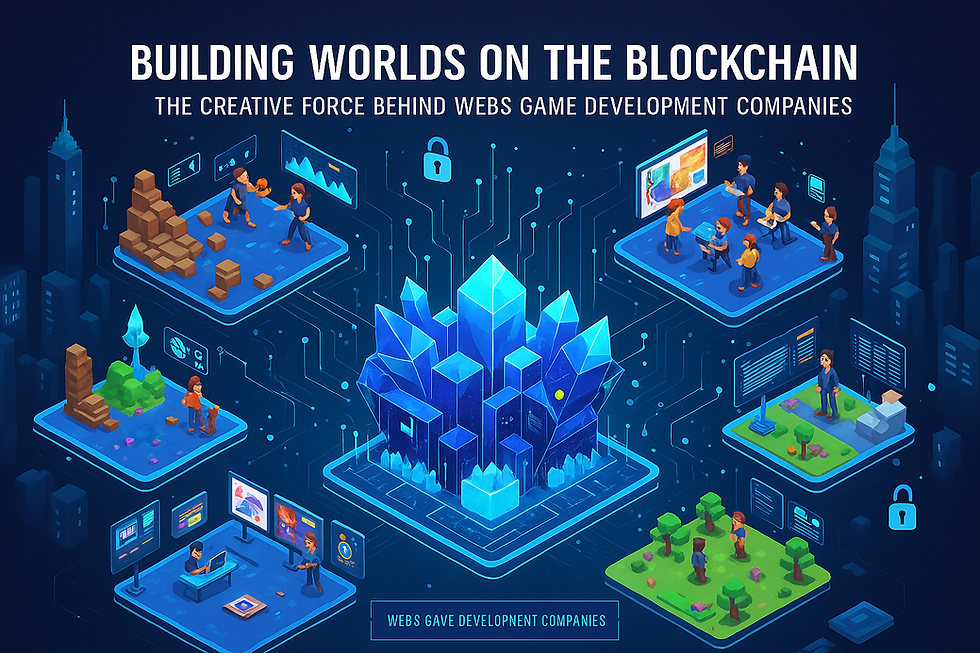
Introduction: When Gaming Meets the Future
Remember when owning a rare sword in your favorite game meant absolutely nothing outside that game? Those days are fading fast.
We're witnessing something remarkable in the gaming industry—a shift that's not just about better graphics or smoother gameplay. It's about fundamentally changing who owns what in virtual worlds. Web3 game development companies are leading this revolution, and they're not just building games; they're constructing entire economies on the blockchain.
If you've been hearing whispers about "play-to-earn," "NFT gaming," or "decentralized gaming platforms" and wondering what all the fuss is about, you're in the right place. Let's dive into the creative chaos that's reshaping how we think about digital entertainment.
What Makes Web3 Games Different?
True Ownership, Finally
Here's the thing about traditional games: you might spend hundreds of dollars on in-game items, but you don't really own them. The game company does. They can take them away, devalue them, or shut down the servers entirely.
Web3 games flip this script. When you earn or buy an item as an NFT (Non-Fungible Token), it's yours. Actually yours. You can sell it, trade it, or take it to another compatible game. It's like owning a physical trading card instead of renting it.
Play-to-Earn: Gaming with Purpose
Imagine if those hours you spent grinding in games could actually put money in your pocket. That's the play-to-earn model. Players earn cryptocurrency or valuable NFTs through gameplay, creating real economic opportunities.
In some developing countries, people are literally making a living playing blockchain games. That's not science fiction—that's happening right now.
Decentralized Communities
Web3 games often give players a say in how the game evolves through DAO (Decentralized Autonomous Organization) structures. It's democracy in gaming. The community votes on updates, new features, and even how in-game resources are distributed.
The Creative Challenges Web3 Developers Face
Building a Web3 game isn't like traditional game development. It's a whole different beast.
Balancing Fun with Functionality
The biggest challenge? Making sure the game is actually fun. Too many early blockchain games focused so much on the crypto aspect that they forgot about gameplay. Players could smell the cash-grab from miles away.
Today's Web3 game development companies have learned this lesson. They're hiring talented game designers first, then integrating blockchain technology as an enhancement, not the entire selling point.
Technical Complexity
Integrating smart contracts, ensuring transaction security, managing gas fees, creating sustainable token economies—it's complex stuff. Developers need to understand both gaming and blockchain technology deeply. It's like being bilingual, but for code.
Scalability Issues
Blockchain networks can get congested. Nobody wants to wait 10 minutes for a transaction to confirm in the middle of an intense battle. Web3 developers are constantly innovating with layer-2 solutions and sidechains to keep gameplay smooth and responsive.
How LBM Solutions Is Shaping the Web3 Gaming Landscape
Companies like LBM Solutions are at the forefront of this transformation, bringing both technical expertise and creative vision to Web3 game development.
What sets specialized firms apart is their holistic approach:
End-to-end development: From concept to launch, covering game design, blockchain integration, smart contract development, and post-launch support
Cross-chain capabilities: Building games that work across multiple blockchain networks, giving players flexibility
Sustainable tokenomics: Creating in-game economies that actually work long-term, not just pump-and-dump schemes
Player-first design: Prioritizing user experience while leveraging blockchain benefits
LBM Solutions and similar forward-thinking companies understand that Web3 gaming isn't just about slapping NFTs onto existing game models. It's about reimagining what games can be when players have real ownership and economic agency.
The Building Blocks of Web3 Game Development
Smart Contracts: The Engine Room
These self-executing contracts handle everything from item ownership to tournament rewards. They're transparent, tamper-proof, and run exactly as programmed. Think of them as the rules of the game written in unbreakable code.
NFT Integration
Characters, weapons, skins, land—anything that can be owned in-game can become an NFT. This creates genuine scarcity and value. That legendary armor you earned? There might only be 100 in existence across all players worldwide.
Cryptocurrency Wallets
Players need wallets to store their assets and earnings. Web3 developers are working hard to make wallet integration seamless because, let's be honest, crypto wallets can be intimidating for newcomers.
Interoperability
The holy grail of Web3 gaming is interoperability—using your assets across multiple games. Imagine your character's outfit from one game being wearable in another. We're not fully there yet, but progress is happening.
Real-World Success Stories
Axie Infinity showed the world that play-to-earn could work at scale, with players earning meaningful income during the pandemic.
The Sandbox is creating a virtual world where players build, own, and monetize their gaming experiences using NFTs and blockchain.
Gods Unchained proved that blockchain-based card games can compete with traditional giants like Hearthstone in terms of gameplay quality.
These aren't just experimental projects anymore. They're viable businesses with active player bases and thriving economies.
The Road Ahead: What's Next?
Web3 gaming is still in its early days. We're basically in the "dial-up internet" phase of this technology. Here's what's coming:
Better Graphics and Gameplay
As the technology matures, Web3 games will match and exceed traditional games in production quality. The blockchain element will become invisible to players—just seamlessly integrated.
Mainstream Adoption
Major game studios are watching closely. Some are already experimenting with blockchain integration. When the big players fully commit, Web3 gaming will explode.
Regulation and Legitimacy
As governments figure out how to regulate cryptocurrency and NFTs, the industry will gain legitimacy and stability. This might slow some things down initially, but it'll ultimately be healthier for everyone.
New Game Genres
We haven't seen anything yet. Creative developers will invent entirely new game genres that only work because of blockchain technology. The next big gaming phenomenon might be something we can't even imagine today.
Conclusion: More Than Just Games
Web3 game development companies aren't just creating entertainment—they're building new economic models, testing decentralized governance, and proving that digital ownership can be real and meaningful.
Yes, there are challenges. The technology is complex, the learning curve is steep, and plenty of projects will fail. But the creative force behind this movement is undeniable. When passionate game developers combine their craft with the possibilities of blockchain technology, amazing things happen.
Whether you're a gamer curious about what's coming next, a developer considering entering this space, or an investor looking for the next big thing, Web3 gaming deserves your attention.
The worlds being built on the blockchain today might just be the gaming platforms your kids grow up playing tomorrow. And unlike the games we grew up with, the items they earn will actually belong to them.


Comments